
Sinbad’s Methods of Investigation
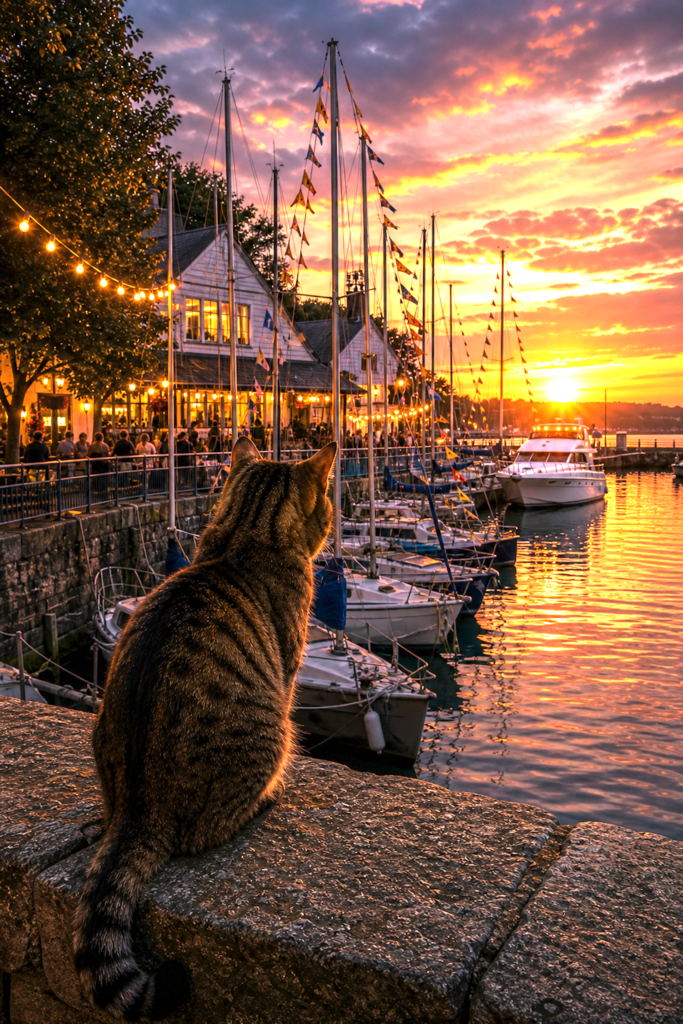
I’ve always had a soft spot for cats who seem to belong not just to a house, but to a whole world. And cats who have a talent for finding clues! Sinbad, the commodore’s cat in The Sailing Club Mystery, is very much that kind of creature. He isn’t merely a cosy mystery cat with a talent for appearing in the right place at the right time; he’s a sailor’s cat. And that gives him a rather more nautical outlook on life. He knows the rhythms of the sea, understands the pull of the tides, and takes a great deal of interest in the quay, the boats, and whatever is moving out on the water.
That, to me, made him especially delicious to write about. He isn’t just watching the humans. He sees the big picture and how it centres around the water, too.
A cat with sea legs
Sinbad has the air of a cat who has been shaped by salt wind and routine. He knows when the tide is changing. He loves it when the quay is busy and also when it settles into a quieter mood. He seems completely at home in a world of ropes, rigging, boat decks, and the slow shifting patterns of the weather. He’s not a cat who merely tolerates the tides; he understands them.
And that matters, because in a sailing setting, the sea is never just scenery. It is part of the atmosphere, part of the tension, part of the story’s pulse. Sinbad fits into that world beautifully. He feels like the sort of cat who knows the difference between a calm afternoon on the quay and a night when something is wrong on the water.
Down to the quay
One of the loveliest things about Sinbad is that he clearly loves his little excursions down to the quay to watch the boats. That detail tells you so much about him. He’s curious, but not hurried. He likes to observe the comings and goings, the bobbing of masts, the movement of hulls, the sudden flash of light on water. It’s a wonderfully feline pastime, and also a wonderfully sailorly one.
Sinbad is also wise, as all cats are. He knows when something’s up.
Reading the tides, reading the room
Sinbad’s investigative talent, I think, comes partly from the fact that he reads the tides as well as the people. He knows that timing matters. He understands movement, rhythm, and pause. That makes him exactly the right sort of cat for a mystery story. While humans are busy asking questions and jumping to conclusions, Sinbad is noticing patterns. He sees human emotions, or when something is out of step. As a commodore’s cat, he’s especially tuned into the atmosphere in the sailing community.
And because he belongs to the sailing world, his observations feel doubly apt. A sailor watches for weather, current, and tide; a cat watches for mood, movement, and change. Sinbad does both. He seems to understand that the sea and the story are alike in one important way: neither of them gives up their secrets all at once.
Why this makes him such a good cosy mystery cat
I think this is why Sinbad works so well in a cosy mystery setting. He brings all the familiar pleasures of a cat character: warmth, mischief, a little independence, but he also brings the texture of the sailing world. He feels rooted in place. He belongs to the quay, the commodore, the sailing club fraternity, the windowsill, and the shifting edge between land and water.
That gives him a deeper kind of presence. He isn’t just there for charm, although he certainly has that. He helps create the mood of the novel. He reminds us that this is a world where boats matter, tides matter, and the sea is always close enough to shape what people do and what they say. Sinbad belongs to that world in a way only a true sailor’s cat can.
In other words, he’s the perfect companion for Harmony Stone as she gets pulled into solving another crime: observant, atmospheric, and just a little bit wiser than the humans around him.
Which, honestly, is exactly how a good cat should be.