
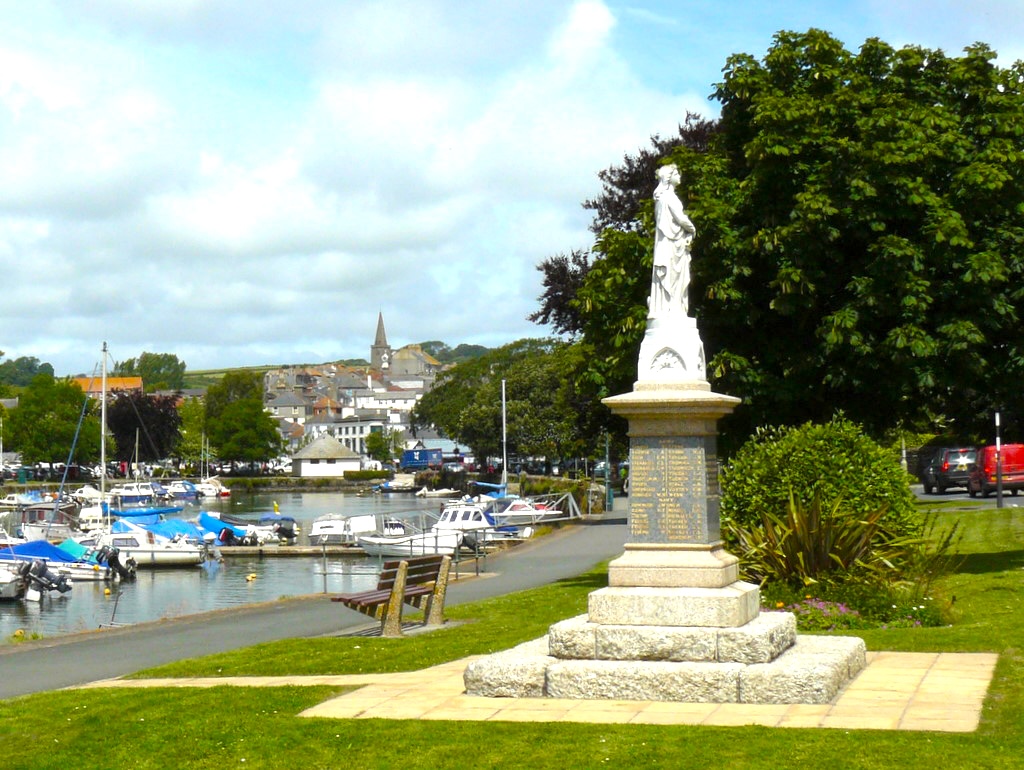
There’s something particularly lovely about a South Devon morning on the estuary.
An egret stands on the mud at the tideline as though it has been there since the Bronze Age, and possibly has. Strings A bank of fog sits low over the pewter-grey water, doing no harm, going nowhere.
I’ve been here on moments like this more times than I can count. And every single time, I think: this is Kingscombe.
Kingscombe Doesn’t Exist
I should be honest about that from the start. It’s a fictional estuary town, set somewhere in the South Hams of Devon with a market square, snug cafes, a bookshop, a sailing club, pubs, and a high street where everyone knows which car belongs to whom.
It’s also a community with the long memory that only comes from generations of families sharing the same patch of land, sea and sky. You won’t find it on any map.
But if you know this area of the South West, the creeks and the quays, the beaches nearby and the lanes that drop down to the water, the towns like Kingsbridge with their medieval wool-town bones and their boating-season summers, you’ll recognise Kingscombe immediately.
It is every inch of it, the South Hams, storified.
Perfect For Cozy Mysteries
What makes this landscape so irresistible for a cozy mystery set in Devon is the same thing that makes it feel slightly out of time. Namely, that the past doesn’t leave here. It goes quiet and waits a while.
The South Hams is layered in the way that only very old, very settled places are. Bronze Age traders moved tin through these estuaries long before anyone thought to write it down. Medieval merchants built the wool towns that still shape the high streets. Smugglers and privateers who knew every creek and inlet along this coastline, and the locals knew perfectly well what was happening, and largely looked the other way.
Then the Second World War came and left its own grief: the American servicemen who lost their lives during Exercise Tiger in Slapton Sands, the thousands evacuated to make way for this secret operation. They are all remembered to this day, a sudden rupture in the pastoral quiet.
All of that is still here, under everything. You just have to know where to look, which is, of course, exactly the kind of place where mysteries happen.
A Sailing Club Nearby
There’s a specific kind of community that forms around a sailing club, especially in a small coastal town where the same families have been racing the same stretch of water for years.
Like any club, it has its own rituals and hierarchies. Summer regattas that matter enormously to the people involved. Old rivalries that are never quite discussed directly. Newcomers who are welcomed warmly and assessed quietly. A shared language of tides and weather which doubles as a shared language for almost everything else.
It’s rich territory for secrets. It’s also warm, vivid, and entirely human. Which is fertile territory for a mystery novel.
Agatha Christie’s Legacy
I should confess something: I’ve been a Christie fan for as long as I can remember. Long before I understood what made her so enduringly brilliant: the misdirection, the social observation, the way her communities hum with things nobody quite says aloud, I simply loved her. The puzzles, the characters, and the sense that ordinary life, looked at closely enough, is absolutely full of secrets.
And then, somehow, I ended up living here. Bigbury Beach is just over a mile from my front door. Burgh Island, that extraordinary tidal island, reachable by sea tractor at high tide, which inspired one of her most celebrated novels, sits just off the coast. Greenway, her beloved summer home, is a short drive away. The South Hams is Christie country in the most literal sense.
What her legacy taught me, and what this landscape teaches anyone who pays attention, is that place and story are not separate things.
Devon has depth. The light changes fast here, the sea is close and the history goes back a long way. And small communities in beautiful places have always understood that beauty and secrecy are not opposites. They keep excellent company.
That’s the tradition I’m trying to work within. Not to imitate her, Agatha Christie is a legend and nobody should attempt that, but to write with the same love of place, the same faith that a well-chosen setting can hold an entire world, and the same conviction that the most interesting questions are always the ones people have been quietly not asking for years.
Who is Harmony Stone?
Harmony Stone, my amateur sleuth, the character at the centre of the Harmony Stone series, is, I think, exactly the kind of person this landscape produces. She’s curious without being intrusive, observant without being cold. She taught history and psychology before she found herself drawn accidentally into the less academic business of working out who did what to whom and why, and she brings both to everything she notices.
She’s a bit of a nomad, as I have been in my own life. House-sitting and cat-sitting give her character new experiences with each novel, although one day she might settle down. In The Sailing Club Mystery, she’s looking after Sinbad, the commodore’s cat, who has a knack for always being in the right place at the right time. He contributes to this investigation primarily by sitting on paperwork and judging people.
What Harmony sees in Kingscombe is what I see in the South Hams: a place with beauty on the surface and depth underneath, where the question is never just what happened but what was always there, waiting.
A Midsummer Mystery
The Sailing Club Mystery, Book 2 in the Harmony Stone Murder Mystery series is set in the height of midsummer. The estuary is full of boats. The regatta flags are out. The town is at its most golden, its most social, its most outwardly cheerful. And something old is beginning to surface, as it always does in places with long memories.
I can’t say more than that without spoiling things. But the atmosphere of the book is very much this: summer in Devon, the energy of regatta season, and the sense that a small town at its most beautiful is also a small town where secrets have a habit of coming to light.
Kingscombe Is A Character Too
A word about setting, because I think it matters: my favourite cozy mysteries are the ones that make me feel like I’m inhabiting a place rather than reading about one. They’re never really just about the crime. They’re about somewhere that might be real. The mystery is the engine, but the setting is the world.
Kingscombe isn’t a backdrop. It’s a character in its own right, and the reason the story can happen at all. The kind of cozy mysteries many readers love most are the ones where the place feels as real as the characters. Places where you’d know which pub Harmony walks past on her way to the market square, and what kind of cafe serves a proper Devon cream tea.
That’s what I’m trying to build, here in my writing cave, on the South Devon coast. A world you can come back to.
You Can Visit Kingscombe
Kingscombe is fictional. The estuary that inspired it is not. If you ever find yourself in the South Hams, standing on a quay with a coffee, watching an egret pretend it owns the mud when the tide is out, you’ll understand why it became a place where mysteries might unfold.
And if you’d like to visit Kingscombe in your imagination: You can find The Mystery of Mossington Manor here; and The Sailing Club Mystery launches on 30 June. I hope it feels, when you open it, like coming back to somewhere you already know.