
Hello there, fellow secret society members!
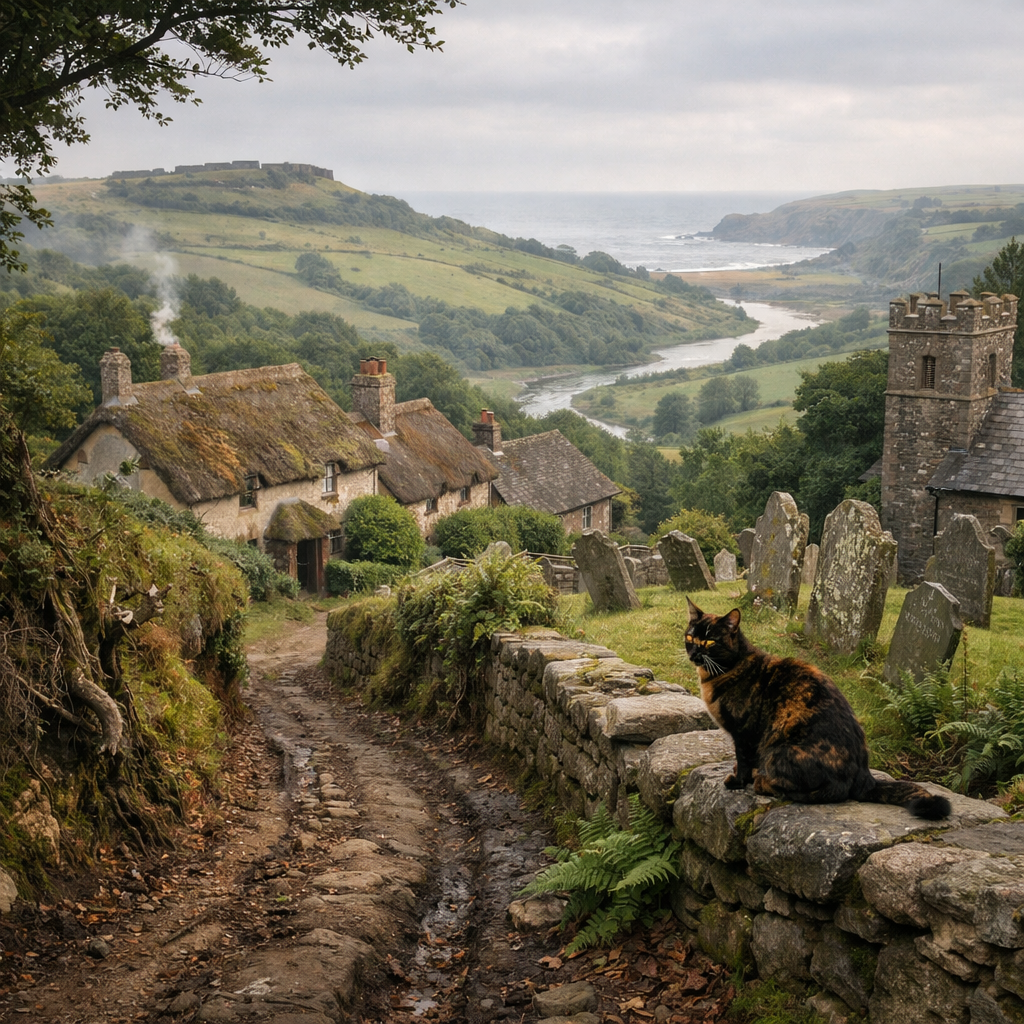
If you’ve been following my new life in the South Hams, you’ll know that I didn’t exactly get the quiet retirement I was promised. When I packed up my classroom and moved to the fictional, yet oh-so-vivid town of Kingscombe, I expected my biggest challenge to be teaching Carruthers (my tortoiseshell cat with a very particular attitude) that the kitchen counters are off-limits.
Instead, I found myself knee-deep in something much more interesting: a landscape that remembers everything, even the things people want to forget.
For a history teacher like me, the South Hams isn’t just a beautiful patch of Devon; it’s a living archive. Here’s why this rugged, coastal corner of the world is the perfect place for a bit of amateur sleuthing.
1. A Landscape Carved by Time
The South Hams is like a beautifully layered cake of human history. When I take Carruthers for a (highly supervised) stroll through the rolling hills, I’m not just looking at the view; I’m looking at a timeline.
Take the Iron Age hillforts that dot our horizon, like the silent sentinels at Stanborough Camp.
They’re a constant reminder that humans have been defending their “turf” here for millennia. And then there’s the name “Kingscombe” itself—it whispers of Saxon roots and royal valleys.
When you understand the ancient boundaries of a place, you start to see the modern ones much more clearly.
2. The Architecture of Hidden Truths
One of the things I love most about our corner of Devon is that the buildings are remarkably honest, even when the people inside them aren’t!
The local architecture is a treasure trove of clues.
Those charming cob and thatch cottages? They aren’t just for show; they tell a story of the very soil they were built from.
And don’t even get me started on the churchyards! I love a good churchyard… In a cozy mystery, a graveyard is the ultimate archive. I’ve lost count of how many times a recurring family name on a weathered 17th-century headstone has provided the missing link in a modern-day puzzle.
3. The Sleuth’s Advantage: The Historical Method
People often ask me how a history teacher ends up solving crimes. The truth is, history and private investigation are essentially the same job. It’s all about:
- Sifting the Source Material: Just as I’d evaluate a primary source document for bias, I evaluate a suspect’s alibi. Who stands to gain? What’s being left out?
- Connecting the Dots: This land has seen everything from Viking raids* to the secret preparations for D-Day. When you live in a place where “the old way” still dictates modern paths, you learn that nothing is ever truly forgotten.
4. The Allure of the “Sunken Path”
If you visit us in Kingscombe, you must walk through a holloway.
These are ancient, sunken lanes worn down by centuries of travelers. To a tourist, it’s just a narrow, atmospheric road. But to me, it’s a perfect metaphor for a cold case. The more a path is used, the deeper the impression it leaves—even if the person who walked it is long gone.
And if you have trouble finding the small town of Kingscombe, there are plenty of holloways along the South Hams Way. It’s a new 100-mile walking route, which passes through the South Devon National Landscape, and features these deep, tree-lined, and sunken lanes. After a year or two of cat-sitting, I fully intend to walk this route myself!
As I often say to my friend Samuel (our local rugged fisherman and retired cop, who is slowly learning to appreciate my “academic” approach): “The South Hams doesn’t give up its secrets easily. You have to be willing to dig—sometimes literally—to find where the harmony was broken.”
So, next time you’re tucked up with a cream tea and a good mystery, remember: the past isn’t just behind us. In a place like Kingscombe, it’s right under our feet, waiting for someone with a sharp eye (and perhaps a sharp-eyed cat) to find it.
Stay curious,
Harmony Stone
- *And yes, there were Viking raids in South Hams area of Devon, with evidence of their activity dating to the late 9th and 10th centuries. While the main Viking settlement (the Danelaw) was in the north and east of England, the South West coast, including Devon, suffered from targeted, opportunistic raids. There’s evidence to show that Viking longboats sailed up the River Dart to raid local villages…