
Two Articles By Harmony Stone for the Kingscombe Gazette
Writers have lots of ways to get to know the characters and settings for their stories.
We like to really get to know them.
As part of my research into the character of Harmony Stone, I imagined her writing articles for the Kingscombe Gazette.
Writing her first two articles, Impressions of Kingscombe, and A Short History of Mossington Manor, helped me get to know a bit more about her, and the small town in Devon where the Harmony Stone Murder Mystery series is set.
Writing from her point of view also helped me learn much more about the history of the fictional Mossington Manor!
N.B. I think I’ve fallen in love with this crazy house…
ARTICLE 1: Impressions of Kingscombe
Our guest writer this week, retired head of history at Greenacres Girls School in Exeter, has recently moved to the area.
As a child, we always came down from Exeter to the South Hams for holidays, staying at the campsite overlooking Burgh Island.
That’s when I fell in love with this area.
I got to know the town of Kingscombe through a friend at university, Gemma Alford (now Pelsone), who lives at Littledown farm. The town itself is unusual. It sits at the head of a ria, a mile and half from the sea. Also known as a drowned river, this particular ria was made during the last ice age. It looks like a tidal estuary, but it’s not fresh water. Here, the sea comes inland like a memory twice a day, changing everything.
Which makes Kingscombe not a river town so much as a tide town. The quay stones shine or dry by turns, mooring ropes slacken and tighten, and dinghies tilt in the mud at low tides.
Trading from all parts of the ancient world took place on the nearby coast as far back as the Bronze Age, and possibly even earlier.
There’s also evidence of extensive Roman settlement in the area, probably related to trade with the eastern Mediterranean and parts of North Africa.
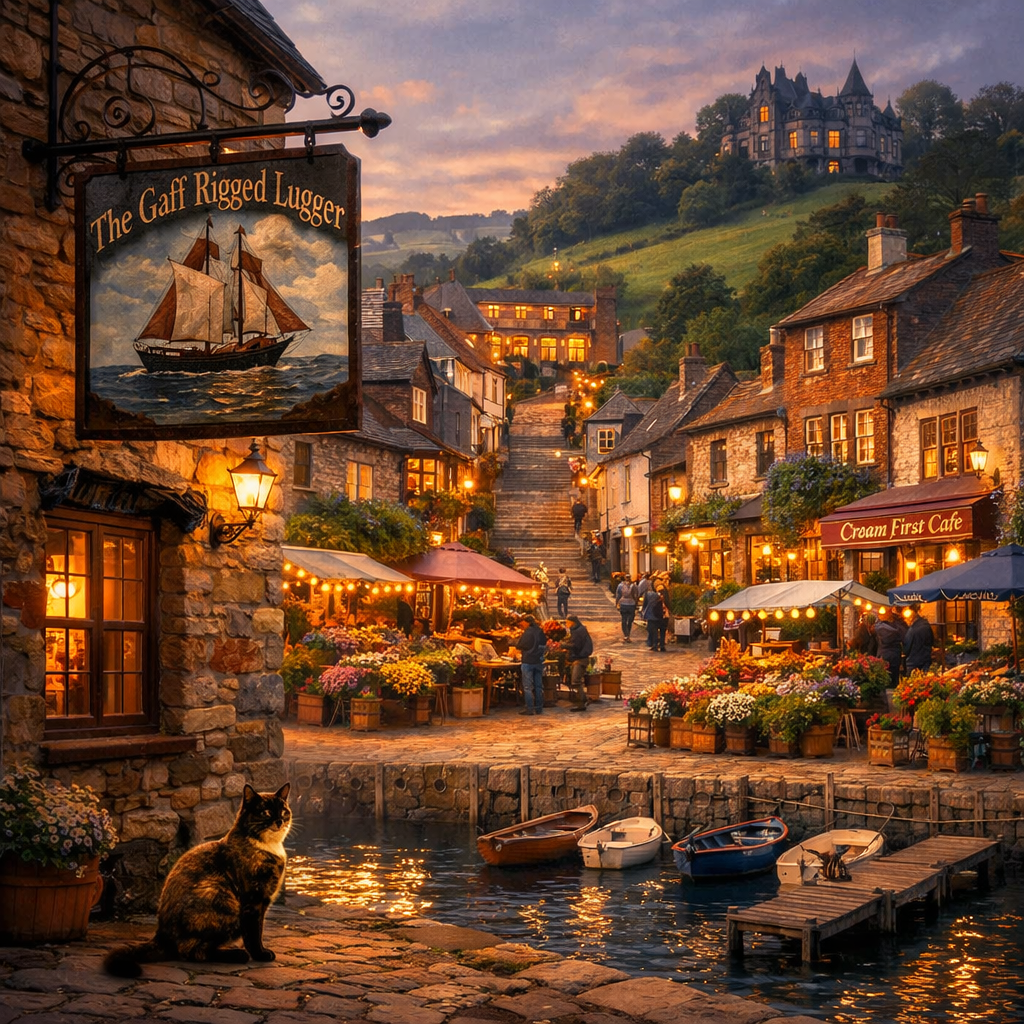
Surrounded by rolling hills, the steep High Street leads down to the water. In so many ways, this place is small enough to feel held together by history and tides. Benches, a band stand, the Gaff Rigged Lugger pub, and an ice cream shack mean that many town gatherings take place around the market square at the end of the quay.
Right at the bottom of the hill is the Cream First café, and climbing upwards and inland you find the church and a collection of useful and quirky shops. St Petroc’s church rises above it all in weathered stone.
At the Buy The Book bookshop, life is quieter and slower, an informal intelligence office disguised as a bookshop, with its soft hush, stacked spines, and a sagging sofa in the corner.
And not far off, the Antique Emporium offers another kind of shelter. Warm, cozy, and faintly golden, full of old clocks, brass compasses, naval prints, leather-bound books, and collections of mariner’s trunks. Adam, the retired naval man who keeps it, has the tidiness of a deckhand and the watchfulness of someone long used to changes in the weather.
Several miles from town, across the estuary’s reach and on a bluff opposite the manor, lies Morning Cove, where the land feels wilder and more private.
In late spring, when I arrived here, I found the slopes washed with bluebells, and sea mists drifting in without warning, thinning and thickening over the path, the cliff edge, the low stone walls, softening the world even as they conceal it.
It is beautiful in that deceptive Devon way, with tender light, fields green with rain, birdsong, and then suddenly no sightline beyond a few yards. A person could approach unseen if they knew the weather, the paths, and the hour.
Inland, nestled in the valley below Morning Cove cliffs, stands Mossington Manor, a Gothic Victorian house that’s been under renovation for the last years.
In Kingscombe, the landscape is never just a backdrop. The estuary, the church, the shops, the manor, the cove, the fishmonger and tackle shop, all of it belongs to the same living clock, and the town’s community is knotted through every bell, kettle, ledger, mooring line, and chimney stone. I’m so happy to have come here, and made it my home.
ARTICLE 2: A Short History of Mossington Manor
By Harmony Stone, retired history teacher, writing for the Kingscombe Gazette.
I’ve been a history teacher long enough to know that the most interesting question about any old building is rarely the one everyone asks. People want to know how many rooms it has (Mossington has 40–50 rooms, depending on what you’re counting (bedrooms, service rooms, attic rooms, conservatory spaces, etc.), who built it, or whether there’s a ghost.
But for me, the most interesting question is always this: what was here before?
Mossington Manor is easy to admire and easy to misread. That dark Victorian frontage, the steep gables, the army of chimneys, the gargoyles that look like they’re waiting to pounce.
All of it was designed by a man called Septimus Vale of Exeter, sometime between 1854 and 1858. Vale was building for a client who wanted Gothic grandeur, and he delivered it. But he was also building on ground that had been accumulating stories for considerably longer than he had.
The house as it stands was rebuilt after a fire in 1853, a bad one, beginning somewhere in the west wing, and spreading fast through old timber and blocked flues.
Although estate papers record that no lives were lost, there are local legends that many of the staff disappeared afterwards, never to be seen again. Villagers turned out to help save portraits, silverware, ledgers, and books.
Ambrose Everly-Holt chose to rebuild rather than sell up. During the clearance work, labourers reportedly broke through into an old subterranean passage, long rumoured in village talk, but never backed up by any evidence.
What stood before the Victorian house is harder to pin down. The estate papers refer to an earlier, irregular building that had already been substantially altered. There’s evidence of Georgian improvements, which usually means someone added windows and removed anything interesting.
Before that, the record blurs. This is not unusual. Many rural houses, unless recorded in the Doomsday Book, tended to grow by absorbing older buildings, or occasionally, burning to the ground.
The land itself, though, is older than any of the paperwork. The woods to the east of Mossington Manor, used to contain a small circle of standing stones that predate written records. There are references, in oral tradition more than in archives, to a sacred well used by an earlier Celtic community, and to a route through the valley that connected the inland high ground to the estuary.
A Romano-British settlement nearby, probably agricultural, and almost certainly coastal-linked, shows up in scattered fields that have never been fully excavated. The ground has been useful to people for a very long time. Mossington Manor simply happens to be the most recent building we can observe.
I find the gaps in the record more compelling than the facts.
Mossington is well documented as a Victorian house. What lies beneath the documentation, the landscape that drew people to this particular piece of cliff and valley, is where the real history lives.
Whatever stood here first is lost. But Mossington still stands to mark a community of people who lived and worked not far from a coast that thrived as a trade centre in the Bronze Age and possibly earlier.
We’re all looking forward to the final restoration of the manor, and the layers of history that have been revealed.
Many thanks to all at the Heritage Committee, and the leadership of the new Mossington fund, directed under the watchful eye of Lady Cecily Everly-Holt, a descendent of the Norman family of Robert de Everly, gifted Mossington by William the Conqueror.
This article draws on estate papers, local tradition, and surviving descriptions. Some early details remain unverified, which, in my opinion, is when history gets interesting.